
Stone Sourcing: An Honest Look
Stone is not a renewable material. Nothing written here changes that, and any supplier claiming their marble is sustainable in the way a forest is sustainable should be read carefully.
What can be said honestly is that some stone is quarried and worked far better than other stone, that the differences are measurable, and that a buyer can ask questions which push a purchase toward the better end. This covers what those questions are.
The one genuine environmental argument for stone
It lasts. A marble table made this year can still be in use in a century, refinished once or twice, while the furniture around it is replaced every decade. Measured per year of use, a material that survives three generations compares well with one that is manufactured, shipped, used for eight years and landfilled.
That argument only holds if the piece is actually kept. A stone table bought for a rental flip and skipped in five years is worse than the flat-pack it replaced. Longevity is a property of how something is bought as much as how it is made.
What quarrying actually costs
Extraction is heavy industry: diesel machinery, diamond wire saws, water, explosives in some operations, and a landscape that does not return to what it was. Modern quarries in Italy, Turkey, Spain and Brazil operate under real regulation, with rehabilitation plans, water recycling and waste rock reused as aggregate. Others operate under very little.
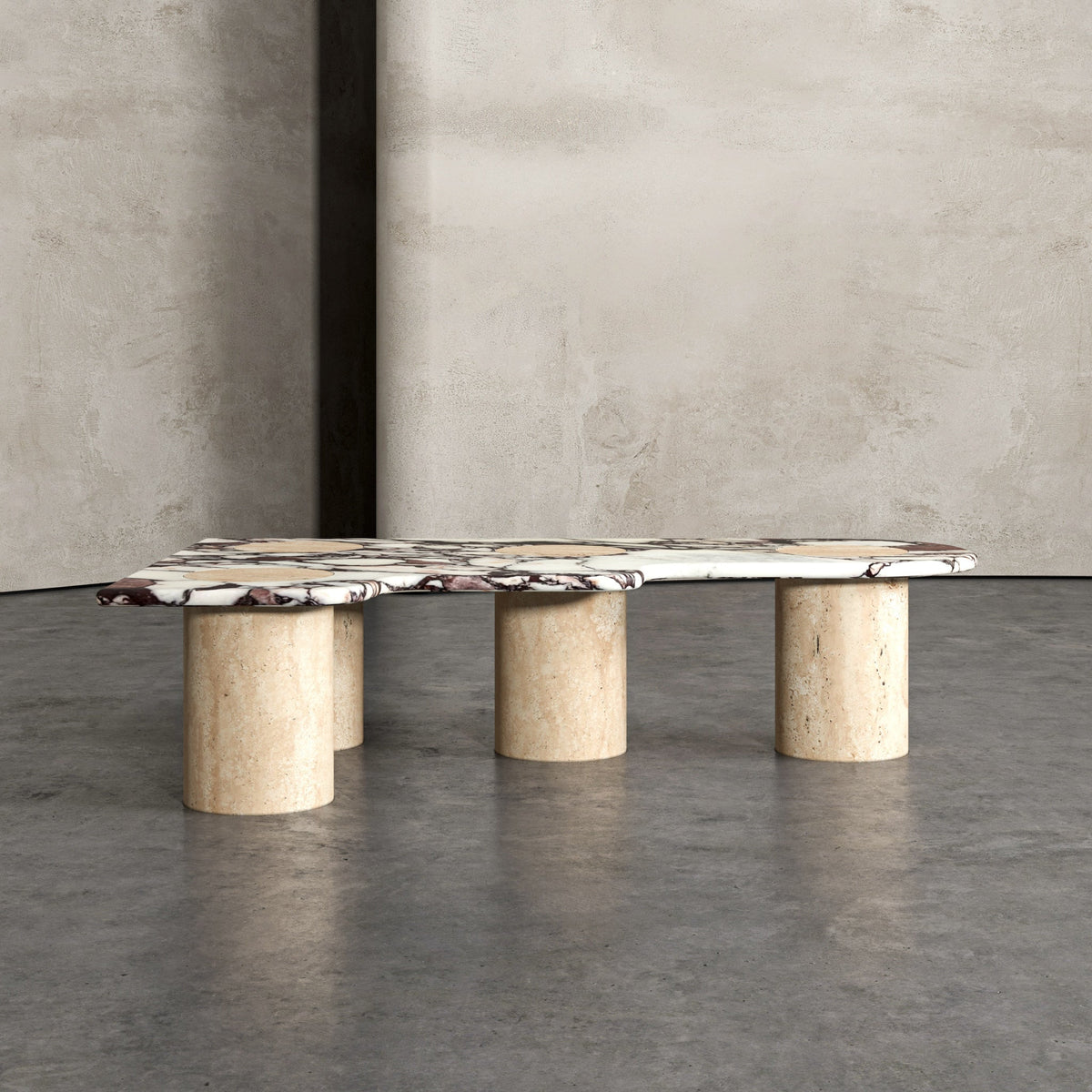
The other cost is waste. A block yields usable slabs and a great deal of offcut, and how a fabricator treats that offcut says a lot. Small pieces become side tables, plinths, bowls, samples and inlay. The rest becomes aggregate or spoil.
Transport, and why it is not the dominant factor
People assume distance is the main impact. For heavy goods moved by sea it usually is not. Container shipping is remarkably efficient per tonne-kilometre, and stone quarried in Italy and shipped to New York can carry a lower transport burden than stone trucked a few hundred miles by road.
Air freight is the exception and is worth avoiding for anything heavy unless a programme has genuinely failed. If a supplier offers to air freight a dining table to save two weeks, understand what is being traded.
The part that is rarely discussed
The serious risks in stone are human before they are environmental. Silicosis from cutting without proper dust extraction, unsafe quarry faces, and labour conditions that range from excellent to indefensible depending on the country and the operator.
These are answerable questions. Where is the stone quarried, and by whom? Where is it fabricated? Does the workshop use wet cutting and extraction? A supplier who knows their quarry and their fabricators can answer in a sentence. A supplier who buys through three intermediaries usually cannot, and that gap is the point.
Questions worth asking any stone supplier
- Which quarry did this block come from, and which country?
- Who fabricates the piece, and do they work in-house or subcontract?
- What happens to the offcut from my slab?
- Is the stone shipped by sea or by air?
- Can the piece be repaired and refinished rather than replaced?
- If it is damaged in ten years, can you still help?
None of these require a certificate. They require a supplier who knows their own supply chain, which is a reasonable expectation at this price level and a useful filter.
Where we stand
We buy through direct relationships with quarries rather than through open-market brokers, which is how clients are able to review and reserve a specific slab before it is cut. Everything is made to order, so we are not producing stock that may never sell, and offcuts go into smaller pieces where the size allows. Finished work is crated and moved by sea.
What we will not claim is that this makes stone furniture an environmentally neutral purchase. It is a heavy material, extracted from the ground, moved across the world. The honest position is that it should be bought rarely, chosen well, and kept.
How to buy stone responsibly, in practice
- Buy for the room you have, so the piece is not replaced when it does not fit the next one.
- Choose a stone and finish that suit how you live, because the pieces that get discarded are the ones that became difficult.
- Ask where it came from, and buy from someone who can tell you.
- Maintain it. A sealed, cared-for surface stays serviceable for decades.
- Repair rather than replace. Chips, etching and dull surfaces are all fixable by a stone restorer.
Every piece in the catalogue is made to order from stone we select at the quarry, and clients are welcome to choose the actual slab. If you want to see what is available before committing, order samples and put them in the room, in the light you actually live with.